


Whether you book NDIS respite in Sydney every school holidays, you are a support coordinator helping families plan their next stay, or you have just started exploring Short Term Accommodation for the first time, there is something you need to know. The pricing changed on 1 July 2026, and it affects everyone.
Until now, STA was billed as a single daily rate. One number, nice and simple. That is gone. Accommodation, support worker hours, and meals are now handled separately, and meals are no longer covered by the NDIS at all.
We know that sounds like a lot. It is. But the good news is that this is not a funding cut. The NDIA has restructured how the bill looks, not how much they intend to fund. The catch is that families, participants, and coordinators all need to understand the new pieces to make sure nothing falls through the gaps.
So let us break it down plainly: what changed, why it matters, and what to do before your next booking.
How STA Used to Be Priced
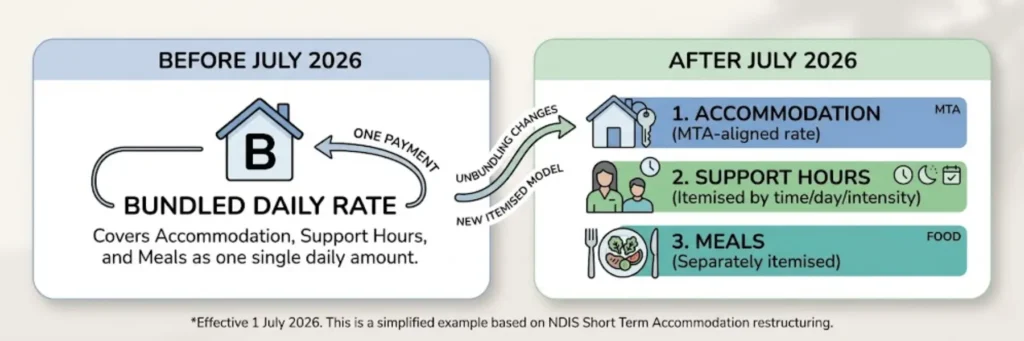
Under the old model, STA was billed as a single bundled daily rate. One line item per day covered the lot: accessible accommodation, personal care from support workers, meals, utilities, and community activities during the stay.
It was simple. Providers claimed one amount, and families did not need to think about how that total broke down. The downside? It was opaque. You could not see how much you were paying for accommodation versus support versus food. And if your family member needed more intensive support, it was hard to tell whether the bundled rate genuinely reflected that.
What Changed on 1 July 2026
The NDIA unbundled STA into separate components. Here is what that looks like in practice:
- Accommodation is now its own line item, set at $162.85 per day – aligned with the existing Medium Term Accommodation (MTA) rate. This covers the room and property costs only.
- Support worker time is billed hourly, not as part of the daily package. The rate depends on the time of day, day of week, and the intensity level of support your family member needs.
- Meals and groceries are no longer included. The NDIA now classifies food as an everyday living cost, the same as buying groceries at home.
The old 1:1 through 1:4 ratio items have been removed entirely. Instead, providers claim support hours based on what was actually delivered during the stay, using the standard disability support worker line items from the NDIS Pricing Schedule 2026-27 (effective 1 July 2026).
The Support Worker Pricing Levels
Support worker rates under the new system vary by intensity level. The NDIS Pricing Schedule groups these broadly as:
- Standard support (Level 1): Routine personal care such as showering assistance, dressing support, and meal preparation. This is the most common level for STA stays.
- High-intensity support (Level 2): Complex personal care needs such as PEG feeding, catheter care, ventilator support, or managing complex medications.
- Level 3 (Guidance and assistance): Psychosocial support, including positive behaviour support during the stay.
- Level 4 (Psychosocial recovery coaching): Specialist recovery-focused support for participants with psychosocial disabilities.
Which level applies to your family member directly affects how quickly your STA budget is used. If you are unsure which level your provider is billing at, ask them before confirming the booking. For more on how NDIS support categories work, visit the NDIS information page on our website.
Why a Saturday Respite Stay Costs More Than a Tuesday
Under the old bundled model, the daily rate was the same regardless of the day. That is no longer the case.
Support worker hourly rates now vary by time of day and day type. As a general guide under the 2026-27 Pricing Schedule:
- Weekday daytime (6am-8pm) is the base rate
- Weekday evening (8pm-12am) and night (12am-6am) attract loadings above the base
- Saturday rates are roughly 40% higher than weekday daytime
- Sunday rates are roughly 80% higher
- Public holidays are the most expensive, at more than double the weekday rate
On top of that, overnight support is billed differently depending on whether it is a sleepover (worker sleeps on-site and is available if needed, billed as a flat per-shift rate of approximately $311.79) or active overnight (worker awake and providing continuous support, billed at the applicable hourly rate).
What does this mean in real terms? A two-night weekend stay during school holidays will draw down your STA budget significantly faster than a midweek stay. If your family member needs active overnight support on a public holiday, a single night could cost several hundred dollars more than a standard Tuesday.
Meals Are No Longer Covered – and That Is a Real Budget Impact
This is the change that families are noticing most. Under the old bundled rate, meals were included as part of the daily package. Now, meals and groceries are classified as everyday living costs.
Your STA provider cannot bill the NDIS for food. The cost comes from the participant’s personal funds, or in some cases, from a separate core support allocation for meal preparation assistance. But the food itself is not NDIS-funded.
For families who relied on NDIS respite in Sydney as a complete break – knowing that everything including meals was taken care of – this is a practical change worth planning for. Ask your provider whether they offer a meal service at an additional personal cost, or whether you will need to provide meals for the stay.
How to Check Whether Your Current Plan Covers the New Pricing

If your NDIS plan was approved before 1 July 2026, the dollar figure allocated for STA was calculated under the old bundled model. That does not automatically mean it is enough under the new itemised billing.
Here is what to do:
- Check your plan under Core Supports (Category 01 – Assistance with Daily Life) for your STA line items
- Talk to your support coordinator about whether your total allocation is still adequate. The unbundling changes how the bill is structured, and in some cases the total may look different once accommodation and support hours are separated
- Ask your STA provider for a sample quote under the new structure before you commit to a booking
- If you think your plan will fall short, your support coordinator can help you explore a plan reassessment or a change of circumstances review
Our FAQ page covers common questions about how NDIS funding works and when to request a review.
Five Questions to Ask Your STA Provider Before Booking
Before you confirm your next respite stay, ask your provider these five things:
- What is the full cost breakdown for my planned stay under the new pricing?
- Which DSW intensity level are you billing at for my support needs?
- Are meals included at a personal cost, or do I need to arrange my own?
- Is overnight support billed as a sleepover or active overnight rate?
- Can you provide a written quote before I confirm?
A good provider will be happy to walk you through the numbers. If they cannot give you a clear answer, that is worth knowing before you book.
The Bottom Line
The STA unbundling is not a funding reduction. The NDIA has been clear that the total spend on Short Term Accommodation is intended to remain comparable. But the new system does require families to understand the moving parts so they can plan accurately and avoid surprises.
If you are a family carer in Sydney, this is the time to have a conversation with your support coordinator and your STA provider. Get a quote under the new structure, check whether your current plan allocation still works, and plan your respite stays with the pricing calendar in mind.
At Dynamic Support Services, we provide short term accommodation and therapeutic respite from our purpose-built facilities in Sydney Olympic Park. We are happy to provide a transparent, itemised quote under the new pricing so you know exactly what your stay will cost. Contact us to discuss your next respite stay, or submit a referral to get started.
Frequently Asked Questions
When did the new STA pricing rules start?
The unbundled STA pricing took effect on 1 July 2026 under the NDIS Pricing Schedule 2026-27. Any STA stay booked from that date onward uses separate line items for accommodation and support, regardless of when your NDIS plan was approved.
Does the new pricing mean I get less respite funding?
Not necessarily. The total funding allocated for STA in your plan was calculated under the bundled model. The unbundling changes how the bill is structured, not the total amount the NDIS intends to fund. However, check with your support coordinator whether your current allocation remains adequate under itemised billing.
Are meals now completely excluded from NDIS STA funding?
Yes. Meals provided during an STA stay are no longer covered by the STA accommodation or support line items. They are classified as everyday living costs. Some participants may have separate core support for meal preparation, but the STA provider cannot bill the NDIS for food.
What is the difference between a sleepover and an active overnight rate?
A sleepover means the support worker sleeps on-site and is available if needed, billed as a flat per-shift rate (approximately $311.79 in 2026-27). Active overnight means the worker is awake and providing continuous support throughout the night, billed at the applicable hourly rate, which is higher.
How much does STA accommodation cost per day under the new pricing?
The STA accommodation rate is $162.85 per day, aligned with the Medium Term Accommodation rate. Support is billed separately at hourly rates that vary by time of day, day type, and the DSW intensity level. Contact your provider for a specific quote based on your support needs.
Can I use my Core Supports flexibly for STA under the new rules?
Yes. STA funding sits within your Core Supports budget (Category 01). Under the new pricing model, you can discuss with your support coordinator how best to allocate your core funds across your support needs.


