


You have probably seen it on Reddit or heard it at a barbecue. Someone mentions their neighbour lives in an NDIS house, and the conversation quickly turns to the idea that the government pays their rent. It sounds reasonable on the surface, but it is wrong. If you are searching for NDIS housing rentals, or trying to work out what a family member will actually pay to live in specialist disability accommodation, you need the real numbers, not neighbourhood rumour.
This article sets the record straight.
The myth that will not go away
A post on the r/NDIS subreddit summed it up perfectly. A participant described how their neighbours genuinely believed the NDIS was covering their entire rent, as if the house were simply handed to them at no cost. The reality was nothing like that.
The confusion usually comes down to one thing: people see purpose-built disability housing, hear that it is “NDIS funded,” and assume the participant pays nothing. But NDIS funding and rent are two completely different payments, going to two completely different places, for two completely different purposes.
Here is how it actually works.
What SDA funding actually pays for: the building, not the rent
Specialist Disability Accommodation (SDA) is a specific NDIS funding stream. It pays for the specialist design features of a dwelling, things like:
- Ceiling hoists and automated doors
- Wider corridors for wheelchair access
- Reinforced walls and impact-resistant fittings
- Backup power for life-sustaining equipment
- Smart-home technology for assistive device control
This funding goes directly from the NDIA to the property owner or registered SDA provider. It is a capital payment that recognises the additional cost of building or modifying a home to meet strict design standards. It does not land in the participant’s bank account, and it is not rent.
Think of it this way: the NDIS pays for the building to exist. The participant still pays to live in it.
If you want to understand SDA in more detail, including the four design categories and who qualifies, the Dynamic Support Services page on Specialist Disability Accommodation in Sydney is a good starting point.
The reasonable rent contribution explained

Every SDA resident pays a reasonable rent contribution (RRC) to their provider. The maximum amount a provider can charge is called the Maximum Reasonable Rent Contribution (MRRC), and it is set by the NDIA, not by the provider.
The formula is straightforward:
- 25% of the Disability Support Pension (DSP) base rate
- Plus 25% of the Pension Supplement
- Plus 100% of Commonwealth Rent Assistance (CRA)
As of March 2026, the MRRC for a single participant was approximately $516.10 per fortnight, or around $258 per week. For a member of a couple sharing a bedroom, the cap was approximately $327.05 per fortnight (NDIS SDA Pricing Arrangements, updated 20 March 2026).
A few important details to keep in mind:
- The MRRC is a ceiling, not a floor. Your provider can charge less, but they cannot charge more.
- The cap applies whether or not you actually receive the DSP or CRA. It is calculated on the maximum rates of those payments, regardless of your personal circumstances.
- The MRRC is updated twice a year, on 20 March and 20 September, in line with DSP indexation. Always confirm the current figure before making financial decisions.
What the participant pays for on top of rent
Rent is just one part of the cost of living. SDA residents are also responsible for everyday expenses that are not covered by SDA funding or their rent contribution. These typically include:
- Utilities such as electricity, water, gas and internet
- Groceries and meals (personal food costs, unless board is included in a shared arrangement)
- Personal items like clothing, toiletries and entertainment
- Transport costs not covered by NDIS plan funding
- Contents insurance if the participant chooses to take it out
- Any damage to the property caused by the tenant
In shared SDA homes where board is provided (covering communal food, household supplies and energy), a separate board contribution applies. As of March 2026, the maximum board amount for a single participant was approximately $564.25 per fortnight. Again, this figure updates twice yearly and should be confirmed at the time of publication.
The key point is that SDA residents are tenants. They have the same rights and responsibilities as any other tenant in New South Wales, including tenancy agreements, bond arrangements and notice periods. The NDIS does not change that.
How SIL funding is different again
This is where another layer of confusion often creeps in. Supported Independent Living (SIL) is a separate NDIS funding stream that pays for the support workers who help a participant with daily living. It covers things like:
- Assistance with personal care (showering, dressing, medication)
- Help with household tasks (cooking, cleaning, laundry)
- Overnight or 24/7 staffing where needed
- Support to build daily living skills and independence
SIL funding goes to the support provider organisation, not to the property owner. A participant can have SDA and SIL in their plan at the same time, and many do, but the two payments serve entirely different purposes.
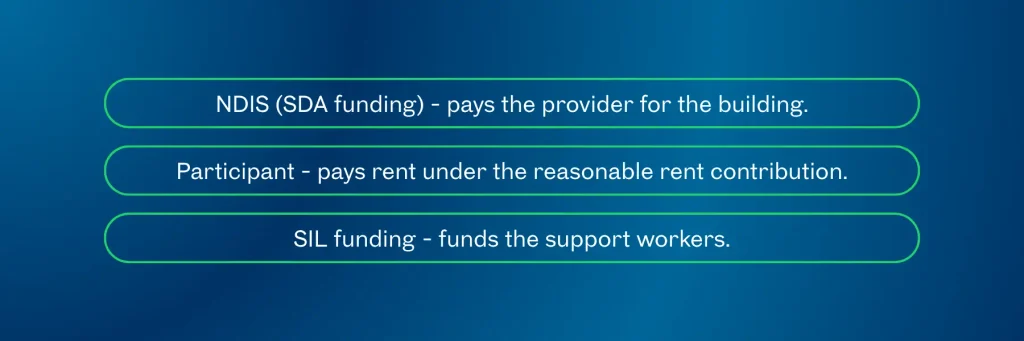
Here is the simplest way to remember it:
- SDA = the building (paid to the property owner)
- SIL = the people who support you inside the building (paid to the support provider)
- RRC = your rent (paid by you to the property owner)
Dynamic Support Services delivers both SDA and SIL across Sydney. You can browse current SDA and SIL accommodation vacancies to see how the two work together in practice.
Why NDIS housing can still be more affordable than the private market
Despite the costs outlined above, NDIS housing rentals are often significantly more affordable than renting on the open market, especially in Sydney. Here is why.
The rent is capped. At roughly $258 per week (as of March 2026), the MRRC is well below the median rent for a one-bedroom apartment in Greater Sydney, which sat above $580 per week during mid-2026 according to multiple rental market reports. For a purpose-built, fully accessible home with specialist features, that is a substantial saving.
Support costs are funded separately. In the private rental market, a person with high support needs would still need to pay rent and then fund their own care, either out of pocket or through NDIS plan funding with no guarantee the dwelling is suitable. In SDA, the building is already designed for their needs, and SIL funding covers the support staff.
Tenancy protections apply. SDA residents are covered by the same residential tenancy laws as everyone else in NSW. Providers cannot increase rent beyond the MRRC, and participants have legal rights around bond, repairs and notice periods.
For families exploring housing options, the NDIS information section on the Dynamic Support Services website explains how different NDIS funding categories work together. The NDIS FAQs page also addresses common questions about SIL, SDA and funding eligibility.
Frequently asked questions
Does the NDIS pay my rent?
No. The NDIS pays SDA funding to the property owner for the specialist features of the building. You pay rent (the reasonable rent contribution) directly to your SDA provider, capped at the MRRC.
How much rent do NDIS participants pay?
The maximum rent for a single SDA participant was approximately $516.10 per fortnight (around $258 per week) as of March 2026. The amount is updated on 20 March and 20 September each year. Your provider may charge less than the cap.
Can my SDA provider charge me more than the MRRC?
No. The MRRC is set by the NDIA and providers cannot exceed it. If you believe you are being overcharged, contact the NDIS Quality and Safeguards Commission or speak with your support coordinator.
What if I do not receive the Disability Support Pension?
The MRRC cap still applies. Your provider can charge up to the MRRC regardless of your income source. The formula is based on the maximum DSP rate, not on what you personally receive.
Where can I find NDIS housing in Sydney?
You can search for SDA vacancies through the NDIS housing portal, ask your support coordinator, or browse available properties on provider websites. Dynamic Support Services lists current vacancies on their accommodation page, covering properties across Western Sydney including Blacktown, Mount Druitt, St Marys and Cranebrook.
Tips for families and participants
- Get the MRRC in writing before you move. Ask your provider to confirm the exact fortnightly rent in your service agreement, and check it against the current MRRC published by the NDIA.
- Budget for expenses beyond rent. Utilities, groceries and personal costs are your responsibility. Factor these into your planning from the start.
- Understand your tenancy rights. You are a tenant, not a guest. You have legal protections under NSW residential tenancy law, including the right to a written agreement and reasonable notice for any changes.
- Ask about board arrangements. In shared homes, board may be included. Clarify exactly what is covered (meals, utilities, household supplies) and confirm the board amount before signing.
- Keep records. Save copies of your service agreement, rent receipts and any correspondence with your provider. If a dispute arises, having documentation makes resolution much simpler.
If you have questions about how rent, SDA funding or SIL supports work together, contact our team at Dynamic Support Services. We are happy to talk it through.
Dynamic Support Services is an award-winning, NDIS-registered provider based in Sydney Olympic Park, delivering Specialist Disability Accommodation, Supported Independent Living, respite and community participation services across Sydney. Call (02) 8964 3106 or visit dynamicsupportservices.com.au.


