


Your mum’s getting older. Your brother’s support needs have changed. Someone at the planning meeting mentioned “SDA” and you nodded along, but honestly, you walked out and Googled it in the car park. You are not alone. SDA is one of the most searched NDIS terms in Australia, and yet most of what comes up online reads like it was written for policy analysts, not families. This guide is the plain English version. It covers what is SDA housing, who it is for, how the funding works and how to find vacancies across Sydney, all without the jargon.
SDA in one paragraph: what it is and what it is not
Specialist Disability Accommodation (SDA) is purpose-built or substantially modified housing funded through the NDIS for people who have an extreme functional impairment or very high support needs. The funding pays the property owner or developer for the specialist features of the building itself, things like ceiling hoists, wider doorways, reinforced walls or smart-home automation. It does not pay for the personal care or daily support a participant receives inside that home. That is a separate funding stream called Supported Independent Living (SIL).
In short, SDA is about the bricks and mortar. It answers the question, “Where will I live?” rather than “Who will help me when I am there?”
If you would like to see how SDA and SIL work together in practice, Dynamic Support Services explains both on its Specialist Disability Accommodation in Sydney and Supported Independent Living service pages.
Who is SDA housing actually for?
SDA is not available to every NDIS participant. According to the NDIS, only a small proportion of all participants, roughly 6%, receive SDA funding in their plans. As of the most recent published data, around 25,274 participants across Australia have SDA funding, though not all of them have moved into an SDA dwelling yet (source: NDIS SDA data supplement via ndis.property, September 2025).
To be considered for SDA funding a participant generally needs to demonstrate all of the following:
- They are an NDIS participant with an approved plan.
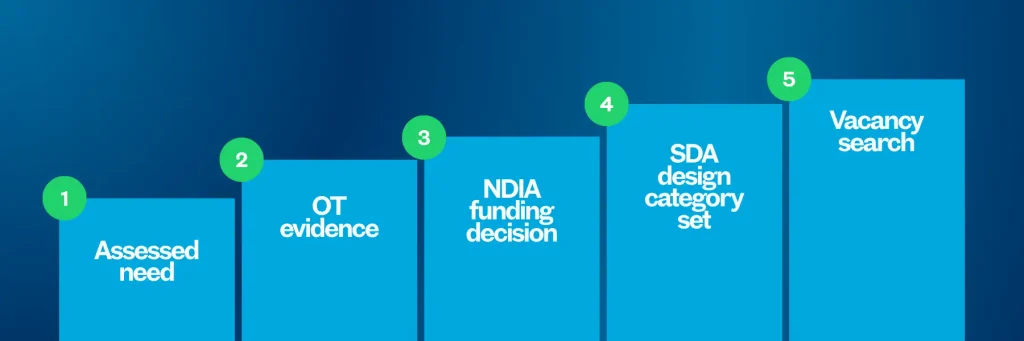
- They have an extreme functional impairment or very high support needs as assessed by a qualified professional, usually an occupational therapist (OT).
- Standard housing, even with reasonable home modifications, cannot meet their needs.
- Living in specialist housing will deliver a clear benefit to the participant, such as greater independence, safety or wellbeing.
- The NDIA Home and Living team has reviewed clinical evidence and approved SDA in the participant’s plan.
The key takeaway for families is this: an OT report is your starting point. If your family member’s current living situation is unsafe, unsuitable or limiting their independence, speak with an occupational therapist who understands SDA eligibility and ask them to prepare a detailed assessment. You can also start your NDIS journey through the resources section on the Dynamic Support Services website to understand the broader planning process.
The four SDA design categories explained
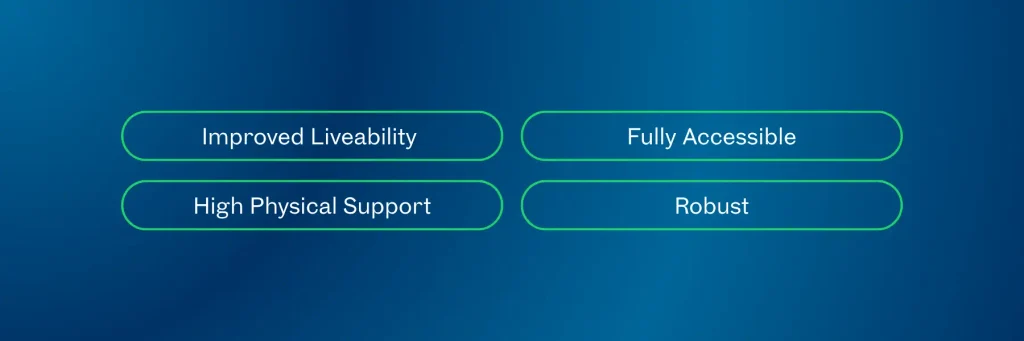
Every SDA dwelling in Australia is enrolled under one of four design categories. The category determines the specialist features built into the home and the level of NDIS funding the property owner receives. The NDIS describes the four categories on its official SDA page, and they are summarised below.
Improved Liveability
Designed for participants with sensory, intellectual or cognitive disabilities who benefit from a home environment that reduces confusion and supports orientation. Think high-contrast colour schemes, consistent lighting, minimal background noise and simplified wayfinding throughout the dwelling.
Suits participants with: autism, intellectual disability, acquired brain injury or sensory impairments who can live relatively independently with the right environmental design.
Fully Accessible
Built for participants who use wheelchairs or other mobility aids and require unobstructed access throughout the entire dwelling. Features include wider corridors, accessible bathrooms with roll-in showers, adjustable kitchen benchtops and step-free entries.
Suits participants with: physical or mobility impairments that require full wheelchair accessibility at all times.
Robust
Constructed with reinforced walls, doors, fittings and fixtures designed to withstand impact and reduce the risk of injury. These homes minimise potential hazards for participants whose disability-related behaviours may otherwise damage a standard dwelling or put themselves and others at risk.
Suits participants with: complex behaviours of concern, severe intellectual disability or conditions where a durable, low-stimulus environment improves safety.
High Physical Support
The highest-specification SDA category. These dwellings include structural provision for ceiling hoists, backup power for life-sustaining equipment, wider doorways to accommodate hospital-style beds and smart-home technology that allows participants to control doors, lights and climate through assistive devices.
Suits participants with: spinal cord injuries, severe cerebral palsy, muscular dystrophy or other conditions requiring intensive physical support and equipment.
How SDA funding works: who pays for the building
One of the most common points of confusion is who actually pays for what. Here is a simple breakdown:
- The NDIS pays the SDA funding directly to the property owner or registered SDA provider. This payment covers the cost of the specialist building features and is calculated based on the design category, the building type (apartment, villa, group home) and a location factor that adjusts for construction costs in different areas.
- The participant pays a reasonable rent contribution, which is typically set at 25% of the Disability Support Pension plus 100% of Commonwealth Rent Assistance. For most participants, this works out to a manageable weekly amount, well below market rent for comparable housing.
- Support costs are funded separately under other parts of the participant’s NDIS plan, usually through SIL or core supports. The SDA payment does not cover support workers, meals or personal care.
In New South Wales, SDA funding is among the highest in the country due to the location factor applied to Sydney and surrounding regions. This is one reason why new SDA developments have been growing in Western Sydney suburbs such as Blacktown, Mount Druitt, St Marys and Penrith, areas where Dynamic Support Services currently operates SDA and SIL accommodation vacancies.
SDA vs SIL vs respite: a quick comparison
These three NDIS supports are related but serve very different purposes. Families often confuse them, so here is a side-by-side snapshot.
| SDA | SIL | Respite (STA) | |
| What it covers | The specialist building and its design features | The support workers who assist with daily living | Short-term accommodation for a temporary break |
| Duration | Long-term, ongoing housing | Ongoing, matched to the participant’s plan | Up to 28 days per year, usually no more than 14 consecutive days |
| Funding goes to | Property owner or SDA provider | Support provider organisation | Respite provider |
| Who it is for | Participants with extreme functional impairment or very high support needs | Participants who need regular assistance with daily tasks at home | Any NDIS participant with respite goals in their plan |
A participant can receive SDA and SIL at the same time. In fact, many SDA homes are operated by providers who also deliver SIL supports within the same dwelling, creating a seamless living and support arrangement.
Dynamic Support Services offers all three services. You can explore the differences in more detail on the respite care page, or check the NDIS FAQs section for common questions about SIL, SDA and STA.
How to look for SDA vacancies in Sydney
Finding an available SDA home that matches the right design category, location and living arrangement is one of the trickiest parts of the process. Here are a few practical steps that can help.
- Ask your support coordinator or plan manager. They typically have direct relationships with SDA providers across Sydney and can match vacancies to your needs quickly.
- Search the NDIS housing portal. The NDIA maintains a searchable listing of SDA vacancies at housing.ndis.gov.au. You can filter by state, suburb, design category and building type.
- Contact SDA providers directly. Many providers, including Dynamic Support Services, list available properties on their own websites. The accommodation page shows current SDA and SIL vacancies across Western Sydney, including properties in Blacktown, Mount Druitt, Cranebrook and South Penrith.
- Join local Facebook groups and disability forums. Sydney-based NDIS community groups often share vacancy listings and provider recommendations before they appear on official portals.
- Get your paperwork ready early. Providers will need to see your NDIS plan (confirming SDA funding), your OT assessment, and any behaviour support or allied health reports. Having these documents ready speeds up the referral process considerably.
If you are not sure where to begin, you can contact our team at Dynamic Support Services. The team can walk you through available options and help you understand whether your current NDIS plan includes SDA, or what steps to take if it does not.
Frequently asked questions
Can I choose where I live if I have SDA funding?
Yes. Choice and control is a core NDIS principle. You can choose which SDA property you would like to live in, provided there is a vacancy that matches your approved design category and the provider agrees the arrangement is suitable.
How long does it take to get SDA in my NDIS plan?
Timelines vary, but the process from OT assessment to NDIA approval can take several months. Having a thorough, well-documented OT report is the single most important factor in reducing delays. Your support coordinator can also advocate on your behalf during the planning process.
Do I have to live with other people in SDA?
Not necessarily. SDA homes range from single-occupancy apartments to shared houses with up to five residents. The NDIS limits the number of residents per dwelling, and providers like Dynamic Support Services conduct a thorough participant matching process to ensure compatibility when homes are shared.
What if my family member does not have SDA in their plan yet?
Start by requesting an OT assessment that specifically addresses housing suitability and SDA eligibility. Then work with your support coordinator to submit a home and living request to the NDIA. The NDIS FAQs page on the Dynamic Support Services website includes additional guidance on navigating the planning process.
Is SDA only for new builds?
No. While many SDA dwellings in Sydney are newly constructed, older properties that have been substantially modified to meet SDA design standards can also be enrolled. The key requirement is that the dwelling meets the specific design category standards and has been assessed and approved by an SDA assessor.
Tips for families starting the SDA journey
- Get the OT report right the first time. Choose an occupational therapist with SDA experience. A generic functional assessment may not contain the detail the NDIA needs to approve SDA funding.
- Understand the difference between SDA and home modifications. If standard housing could be made suitable with modifications such as grab rails, ramps or bathroom alterations, the NDIA is likely to fund modifications rather than SDA. SDA is reserved for situations where standard housing, even modified, is not adequate.
- Visit properties before committing. Arrange a tour, meet the support team and, where possible, have your family member spend a short stay or trial period before making a long-term decision.
- Keep records of everything. Document any incidents, hospitalisations or functional changes that support the case for SDA. This evidence strengthens your application and any future plan reviews.
Dynamic Support Services is an award-winning, NDIS-registered provider based in Sydney Olympic Park, delivering Specialist Disability Accommodation, Supported Independent Living, respite and community participation services across Sydney. To explore SDA vacancies or ask a question, visit dynamicsupportservices.com.au or call (02) 8964 3106.


