


Your NDIS plan says you have SIL funding. Your support coordinator mentions something about “standard” versus “high intensity.” You nod, but you are not entirely sure what the difference means for you, your support team or your budget. You are not the only one. It is one of the most common questions families ask after reading a provider’s SIL page, and it rarely gets a clear answer.
This article explains the two NDIS high intensity supports and standard funding levels used in Supported Independent Living, what each one covers, why high intensity is priced higher and what to look for in your plan.
The two SIL funding levels explained
The NDIS uses two sets of hourly prices for supports delivered in a SIL arrangement. According to the NDIA’s published SIL provider guidance (ndis.gov.au, updated 2026), these are:
- Standard
- High intensity
Most participants will be funded at the standard level. High intensity applies when a participant needs support workers with additional qualifications, training or experience to safely meet their disability-related needs.
The funding level is not something you choose yourself. It is determined during the NDIS planning process based on your assessed support needs, usually informed by an occupational therapist’s functional capacity assessment and, where relevant, a behaviour support practitioner’s report.
For a broader overview of how SIL works, including eligibility and how to apply, the Dynamic Support Services Supported Independent Living page walks through the basics.
What standard support funding covers
Standard SIL funding covers the cost of support workers who help with everyday tasks in the home. This is the level that applies to the majority of SIL participants. It includes assistance with things like:
- Personal care (showering, dressing, grooming, toileting)
- Meal preparation and cooking
- Household tasks (cleaning, laundry, general tidying)
- Medication prompting and management
- Building daily living skills and routines
- Supporting the participant to follow their NDIS plan goals
Standard funding also covers overnight support where required, typically as a sleepover shift (where the worker is on-site and available but not actively awake all night). If a participant needs no more than two hours of active support overnight, the NDIA will generally fund sleepover support rather than an active overnight shift.
The support workers delivering standard SIL do not require specialist clinical skills beyond what is expected under the NDIS Practice Standards. They are trained, experienced disability support workers who can assist with daily living in a shared or individual home environment.
What high intensity support funding covers
High intensity SIL funding applies when a participant’s needs go beyond what a standard support worker can safely deliver. According to the NDIA, a support is considered high intensity when a participant:
- Requires frequent assistance (at least once per shift) to manage challenging behaviours that need intensive positive behaviour support, and/or
- Requires assistance from a disability support worker who holds one or more of the high intensity support skills specified in the NDIS Commission’s Practice Standards skills descriptors
In practical terms, high intensity supports may involve things like:
- Implementing complex behaviour support plans on every shift
- Managing clinical or health-related needs that require additional training (for example, enteral feeding, epilepsy management or complex wound care)
- Supporting participants whose disability-related behaviours present a risk to themselves or others without skilled, consistent intervention
- Delivering active overnight support where the participant needs more than two hours of awake assistance during sleeping hours
The key distinction is the skill level required of the support worker. High intensity funding recognises that these workers need extra qualifications, ongoing specialist training and, often, closer clinical supervision.
Note: this article does not list specific clinical supports (such as tracheostomy care or complex bowel management) as services provided by Dynamic Support Services. If you need information about a specific clinical support, contact our team to discuss your situation directly.
Why the high intensity rate is higher
The NDIS Pricing Arrangements set separate hourly price limits for standard and high intensity SIL. The high intensity rate is higher because it reflects:
- Higher worker qualifications. Support workers delivering high intensity supports must hold specific skills and certifications as defined by the NDIS Quality and Safeguards Commission. This typically means additional training in areas like complex behaviour support, manual handling for high physical needs, or clinical care tasks.
- Greater supervision requirements. Providers delivering high intensity SIL are expected to maintain closer clinical oversight, more frequent team debriefs and additional reporting. This increases the operational cost per shift.
- Increased staffing ratios. Participants on high intensity funding often require higher staff-to-participant ratios, sometimes 1:1 support for all or part of the day, rather than the shared ratios common in standard SIL homes.
- More detailed roster of care submissions. When a provider submits a roster of care to the NDIA for a participant on high intensity funding, they must include clinical evidence (such as OT assessments, behaviour support plans or allied health reports) to justify the higher level. This adds administrative and clinical time.
The higher price does not mean the participant pays more out of pocket. SIL funding is included in the participant’s NDIS plan under Core Supports (Assistance with Daily Life), and the NDIA pays the provider directly based on the approved roster of care. The participant’s personal costs (rent, food, utilities) remain the same regardless of funding level.
Irregular support days: the 10 versus 15 difference
Every SIL participant receives a separate allocation of irregular support days in their plan. Irregular supports cover unexpected situations where additional staffing is needed outside the regular roster of care, for example, when a participant falls ill and cannot attend their usual day program, or when an unplanned incident requires extra support hours.
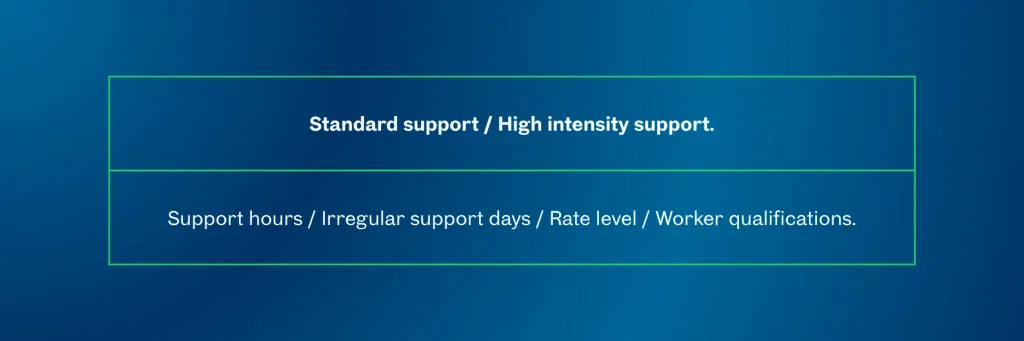
The NDIA generally funds:
- 10 irregular support days per year for participants with standard support needs
- 15 irregular support days per year for participants with high intensity support needs
The higher allocation for high intensity participants reflects the reality that unplanned events tend to be more complex and resource-intensive when a person has higher support needs. A standard participant staying home sick might need one additional worker for the day. A high intensity participant in the same situation might need a worker with specific clinical skills, a higher ratio or both.
Irregular support days are capped. If you use them all, additional funding is not automatically available, so it is worth understanding how many you have and tracking usage throughout the year. Your SIL provider should be able to tell you how many irregular days remain in your plan at any point.
You can find more detail on SIL funding structures, including how regular and irregular supports work together, on the Dynamic Support Services SIL homes and funding details page.
How to check which level is in your plan
If you are not sure whether your SIL funding is set at standard or high intensity, here are a few ways to find out:
- Read your NDIS plan. Look under Core Supports for the “Assistance with Daily Life” budget. The plan or the accompanying letter from the NDIA should reference the support level and the line items approved. High intensity line items contain the words “high intensity” in their description (for example, “Assistance in Supported Independent Living, High Intensity, Weekday Daytime”).
- Ask your support coordinator. They will have access to the plan details and can confirm whether your funding is set at standard or high intensity. If you do not have a support coordinator, your plan manager or local area coordinator (LAC) can help.
- Check with your SIL provider. Your provider’s roster of care submission will specify the funding level. Ask them to walk you through the approved roster so you understand how your hours are allocated across the week.
- Call the NDIA. You can contact the NDIA directly on 1800 800 110 to ask about the support items in your plan.
If you believe your support needs have changed and you require high intensity funding (or if you currently have high intensity funding and your needs have reduced), raise this at your next plan review. Updated clinical evidence from an OT or behaviour support practitioner will strengthen any request for a change in funding level.
For answers to other common NDIS questions, including eligibility and how different funding categories work, visit the NDIS FAQs section on the Dynamic Support Services website.
Frequently asked questions
Can I choose whether I get standard or high intensity funding?
No. The funding level is determined by the NDIA based on your assessed support needs, not by personal preference. Your OT assessment and any behaviour support reports are the key evidence used in the decision.
Does high intensity funding mean I pay more for my accommodation?
No. SIL funding covers the cost of your support workers, not your housing. Your rent contribution (if you live in SDA) or your private rent remains the same regardless of whether your SIL is funded at standard or high intensity. You can browse current SDA and SIL accommodation vacancies to see available options.
What happens if I run out of irregular support days?
If you use all your allocated irregular days (10 for standard, 15 for high intensity), additional irregular funding is not automatically added. Your provider and support coordinator can request a plan review if your circumstances have genuinely changed, but this is assessed on a case-by-case basis.
Can my SIL provider deliver both standard and high intensity supports?
It depends on the provider’s registration and workforce capability. Providers delivering high intensity supports must be registered for the relevant NDIS registration group and employ workers with the required skills. Not all SIL providers are set up to deliver high intensity care.
Tips for participants and families
- Get your OT report right. The functional capacity assessment is the foundation of your SIL funding level. Make sure it accurately reflects your current support needs, including any clinical or behavioural complexities.
- Understand your roster of care. Ask your provider to explain the approved roster, including how many hours are allocated per day, what the staffing ratio is and whether overnight support is sleepover or active.
- Track your irregular days. Ask your provider how many you have used and how many remain. Planning ahead (for example, knowing that public holidays are already built into the regular roster) helps avoid running short.
- Review annually. Support needs change. If your situation has shifted, whether your needs have increased or decreased, raise it early in the plan review process so your funding level can be reassessed with current evidence.
If you have questions about SIL funding levels or want to understand how standard and high intensity supports work in practice, contact our team at Dynamic Support Services. We are happy to help.
Dynamic Support Services is an award-winning, NDIS-registered provider based in Sydney Olympic Park, delivering Supported Independent Living, Specialist Disability Accommodation, respite and community participation services across Sydney. Call (02) 8964 3106 or visit dynamicsupportservices.com.au.


