
Think of a home as two parts: the walls around you, and the people who help you live well inside them. That’s the simplest way to understand SIL vs SDA. SDA is the brick-and-mortar. SIL is the people who provide the support.
Specialist disability accommodation (SDA) is housing designed with features that meet a person’s disability support needs, from wide doorways to ceiling hoists. Supported independent living (SIL) is funding for support workers who help or supervise someone at home, around the clock. They’re separate supports, and some people have both in their NDIS plan. Below, we compare them side by side using the NDIS’s own pages (the SIL page current as of 1 October 2026, and the SDA page current as of 1 July 2026).
The one-line answer
SIL is the support, and SDA is the home.
- SIL (supported independent living) is funding for a support worker to help or supervise you 24 hours a day, 7 days a week.
- SDA (specialist disability accommodation) is a range of housing for people with extreme functional impairment or very high support needs, designed with features that meet those needs.
The NDIS puts the split plainly in its SDA guidance: SDA funding pays the SDA provider, SIL funding pays for your carers, and you pay the rent and bills.
SIL vs SDA at a glance
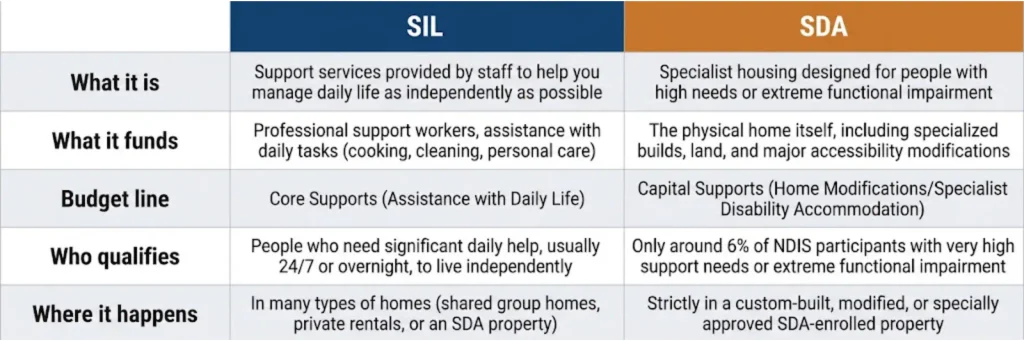
| SIL (supported independent living) | SDA (specialist disability accommodation) | |
| What it is | Funding for a support worker to help or supervise you 24/7 | A range of housing with features designed for your disability support needs |
| What it funds | Support workers in your home | The SDA provider, for the home |
| What it doesn’t fund | Rent, groceries and other day-to-day expenses | Personal care, SIL, ILO and assistive technology |
| Who it’s for | People who need a support worker 24 hours a day, including overnight, with help for at least 8 of those hours | People with extreme functional impairment or very high support needs |
| Where it happens | Within your home, often shared with other participants | A house, apartment, villa, duplex or townhouse enrolled as an SDA dwelling |
| Rent and bills | Not covered | You pay a reasonable rent contribution and living costs |
Source: NDIS pages “What is supported independent living (SIL)” (current as of 1 October 2026) and “What is specialist disability accommodation (SDA)” (current as of 1 July 2026).
What SIL pays for, and what it never pays for
The NDIS describes SIL as funding for a support worker to help or supervise you, 24 hours a day, 7 days a week. You might share a support worker with housemates or have an individual worker, depending on how much help you need.
Support workers can help with daily tasks like:
- personal care, showering and getting dressed
- eating and cooking meals
- household tasks, like cleaning
The NDIS says SIL is designed to help you live as independently as possible while building your skills.
What SIL never pays for: rent, groceries and other day-to-day expenses. It doesn’t pay for the home itself either.
To understand how SIL funding levels work, see our guide to SIL funding levels, or learn more about our Supported Independent Living service.
What SDA pays for, and who it is built for
SDA is the housing itself. The NDIS says SDA is for people with extreme functional impairment or very high support needs, and may be suitable when other home and living supports don’t meet your disability needs.
SDA properties may include features like wide doorways, wheelchair-accessible kitchen sinks, ceiling hoists or button-operated doors. SDA is also grouped by design category:
- Improved liveability: better physical access and features for people with sensory, intellectual or cognitive impairments
- Fully accessible: a high level of physical access, for example for people who use a wheelchair at home
- Robust: very strong and durable, built to be safe for the person and others
- High physical support: a high level of physical access for people who need very high levels of support
The NDIS is clear that SDA doesn’t include supports delivered in the home, such as personal care or SIL.
For a fuller walk-through, read what is SDA housing, or explore our Specialist Disability Accommodation service.
SIL and SDA: can you have one without the other?
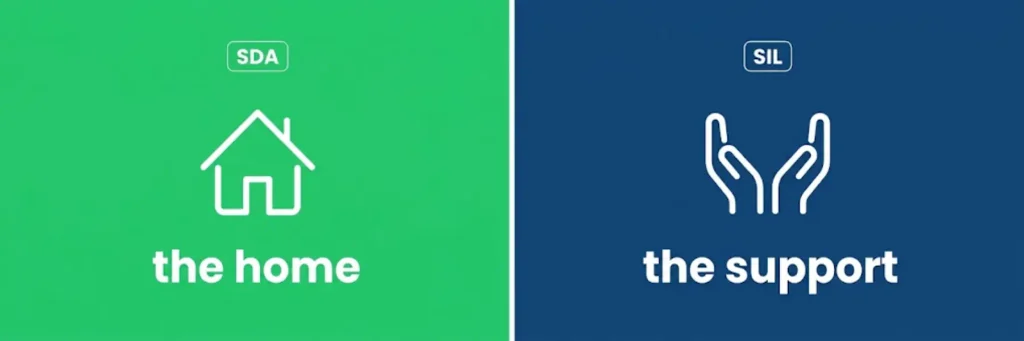
The NDIS describes SIL and SDA as separate supports, each with its own criteria. So the right combination depends on your situation:
- Both SIL and SDA: the NDIS says many participants living in SDA also have funding for in-home supports, like SIL. SDA covers the home, SIL covers the support workers.
- SDA without SIL: because SDA is housing only, people in SDA may get their in-home support in other ways, depending on what’s in their plan.
- SIL without SDA: SIL is about the support you need at home. The NDIS also notes that, other than SDA, it doesn’t fund housing, and most participants have a home by owning, renting or through social housing.
- Neither yet: if you think you might need one or both, start with the NDIS guide on how to ask for home and living supports.
Your myNDIS contact can explain which combination applies to you.
The difference between SIL and SDA in funding and assessment
The two are funded separately. In the NDIS’s words, SDA funding pays the SDA provider, SIL funding pays for your carers, and you pay the rent and bills. With SDA, you pay a reasonable rent contribution and other living costs, like electricity. Our post No, the NDIS does not pay your rent covers rent in detail.
They’re also considered separately:
- For SIL, the NDIS points to its guide on how to ask for home and living supports, with your myNDIS contact as a starting point.
- For SDA, the NDIS says it looks at how SDA will work with your other supports, and whether it meets the NDIS funding criteria.
Providers are separate too. SIL providers must be registered to deliver SIL. SDA providers must be registered, and SDA homes must be enrolled with the NDIS as SDA dwellings.
What this looks like in Sydney
Whether you’re in Sydney or anywhere else in Australia, the same NDIS definitions and rules apply. What changes from place to place is which homes and providers are available near you.
In general terms, the situations a family may be weighing up include:
- needing more support at home, while the home itself still works
- needing a home with specific features, while support is already arranged another way
- needing both a different home and more support at the same time
In each case, the starting point is the same: be clear about whether the home, the support, or both need to change.
Frequently asked questions
Is SIL the same as SDA?
No. SIL vs SDA in one line: SIL is funding for support workers to help you at home, and SDA is specially designed housing. They’re separate supports.
Can you get SDA without SIL?
SDA is housing only, and the NDIS says many SDA residents also have SIL. Whether you need both depends on your situation. Your myNDIS contact can explain what applies to you.
Can you have SIL without SDA?
SIL and SDA are separate supports. SIL is about the support you need at home, while SDA is a type of housing. Your myNDIS contact can explain what applies to you.
Does SDA pay for support workers?
No. The NDIS says SDA doesn’t include supports delivered in the home, such as personal care or SIL. SIL funding pays for support workers.
Which one pays the rent?
Neither. SIL can’t be used for rent, and with SDA you pay a reasonable rent contribution. Read No, the NDIS does not pay your rent for more.
Quick tips for your next planning conversation
- Check how SIL and SDA are each listed in your plan before your plan review.
- If both the home and the support need to change, raise both with your myNDIS contact.
- Keep the two provider decisions separate, so either can change without the other.
- Make sure any SIL or SDA provider you’re considering is registered.
Talk to us about SIL and SDA
Because we deliver both, we can help you work out how SIL and SDA might fit together for you. Learn more about our Supported Independent Living and Specialist Disability Accommodation services.